
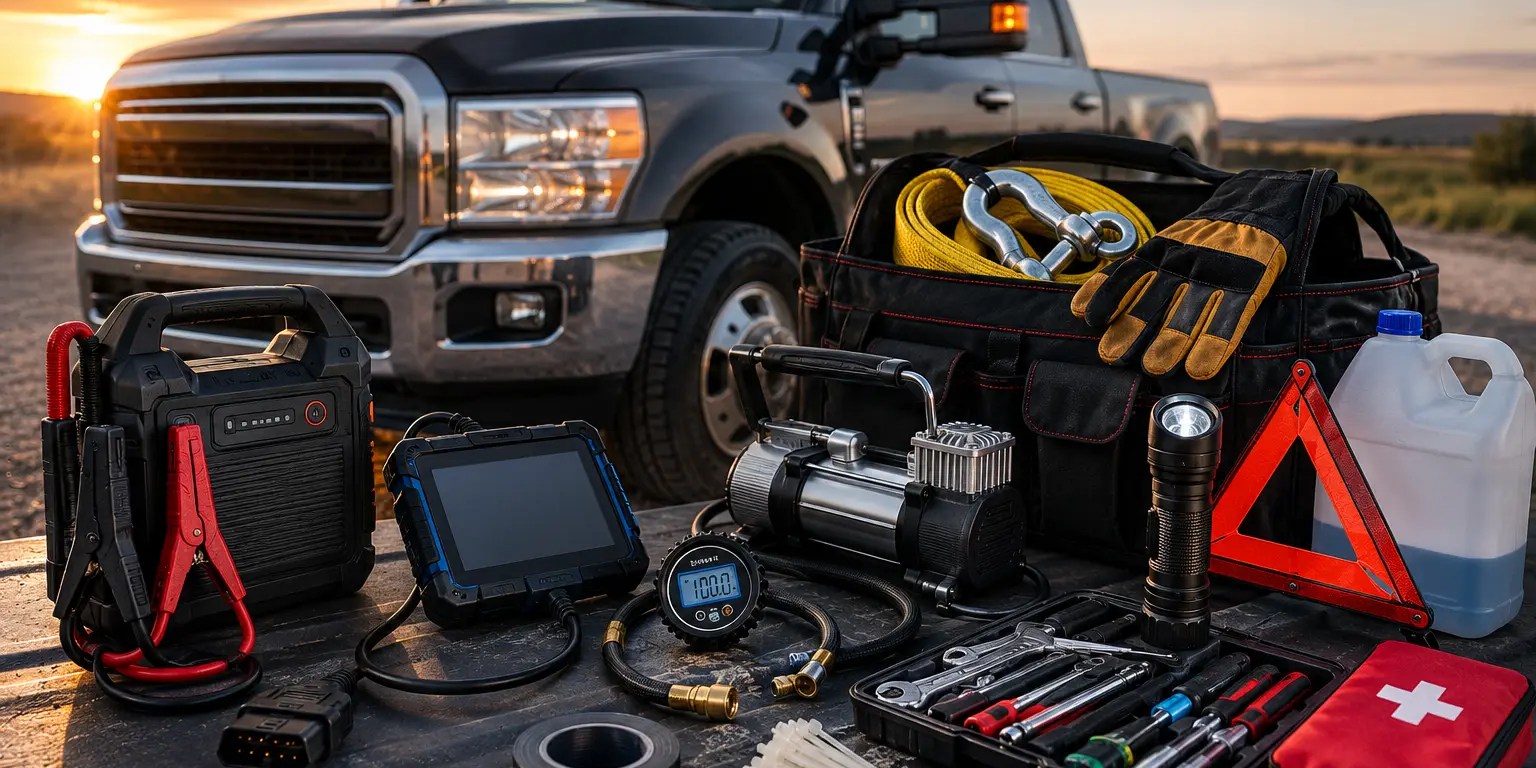
Diesel trucks are built to work. Whether you’re running a heavy-duty pickup on a farm, managing a small fleet of commercial vehicles, or operating an owner-operator rig on the highway, your truck is a tool — and the accessories you carry with it determine how prepared you are when things don’t go to plan.
Breakdowns happen. Sensors fail. Tyres go flat. Batteries die at inconvenient times. The difference between a minor delay and a costly, stressful roadside emergency often comes down to what you have on the truck with you. Here are the accessories that experienced diesel truck drivers consider non-negotiable — not the gimmicks, but the gear that actually earns its place in the cab or the toolbox.
1. Heavy-Duty Jump Starter Pack
Diesel engines require significantly more cranking power than petrol engines to start — particularly in cold weather. A standard passenger car jump starter won’t deliver enough cold cranking amps to turn over a large diesel. Heavy-duty diesel-rated jump starters, typically rated at 2,000 CCA or higher, can start a V8 or inline-six diesel engine without needing another vehicle nearby.
Modern lithium-ion jump starter packs are compact enough to store in the cab and double as USB charging banks for phones and devices. For fleet operators and owner-operators running routes in remote areas or through the night, a quality jump starter is the kind of accessory that pays for itself the first time you need it — which, on a diesel truck, will happen.
2. J1939-Compatible Diagnostic Scanner
This is the accessory that separates informed diesel truck owners from drivers who find out about problems at the roadside. Modern diesel trucks communicate over the J1939 CAN bus protocol — not the OBD-II protocol used by passenger cars — and reading fault codes requires a compatible scan tool.
A J1939-capable scanner lets you read active fault codes before a warning light forces you to stop, clear minor codes after a confirmed repair, monitor live engine data including oil pressure, coolant temperature, and DPF soot load, and confirm whether an active regen is completing correctly. Entry-level J1939 adapters that pair with a smartphone app start from around $100 to $150, while professional-grade platforms offer deeper functionality. For a comparison of what’s available across price points, Heavy Duty Journal’s guide to diesel diagnostic tools for truck owners covers the leading options in detail.
3. Tyre Pressure Gauge and Portable Inflator
Commercial truck tyres operate at pressures between 80 and 110 PSI depending on load and application — well beyond what a standard passenger car gauge reads accurately. A dedicated heavy-duty tyre pressure gauge, ideally a digital model with a range to 150 PSI, gives accurate readings without the drift common in budget gauges.
Pair it with a 12V or 24V portable air compressor capable of inflating truck tyres to operating pressure. Tyre pressure drops with temperature changes — a tyre that reads correctly at noon in summer can be significantly underinflated on a cold morning — and underinflated tyres on a loaded truck generate heat, accelerate tyre wear, and increase fuel consumption. Checking and correcting tyre pressure takes five minutes. Changing a blown tyre on the side of a highway takes considerably longer.
4. Tow Straps and Recovery Gear
If your diesel truck operates off-road, on construction sites, on farm tracks, or through any terrain where traction is not guaranteed, recovery gear belongs on the truck. A heavy-duty tow strap rated for your vehicle’s GVW, a pair of recovery shackles, and a pair of traction boards or recovery tracks will get you out of the majority of stuck situations without waiting for external help.
For on-highway operators, a quality tow strap and a pair of wheel chocks are the practical minimum. Being able to assist another driver — or accept assistance — without improvising with whatever is nearby is worth the modest storage space the gear requires.
5. Comprehensive Roadside Emergency Kit
A proper roadside emergency kit for a diesel truck goes beyond the basic triangles and a torch. For commercial vehicle operators, consider building a kit that includes: road flares or LED warning triangles, a high-visibility vest, a quality torch with spare batteries, heavy-duty work gloves, basic hand tools including adjustable wrenches and screwdrivers, zip ties and electrical tape, a spare fuse assortment, duct tape, and a first aid kit.
Owner-operators and fleet drivers who cover long distances should also carry a spare serpentine belt sized to their engine, a gallon of coolant, and a spare set of air filter elements. These are the consumables most likely to maroon a truck far from a parts supplier, and the carrying cost is minimal compared to the towing bill and lost time an unexpected parts shortage generates.
6. DEF Storage Container
Diesel exhaust fluid (DEF) is a non-negotiable consumable on all diesel trucks built since 2010. Running out of DEF triggers a series of escalating warning messages and, ultimately, a power derate that limits vehicle speed — typically to 5 MPH — until the DEF tank is refilled. In rural areas, remote worksites, and overnight highway stops where fuel stations may not stock DEF, running low can turn into a serious operational problem.
Carrying a sealed 2.5-gallon DEF container in the truck provides insurance against an empty tank at the wrong location. DEF has a shelf life of around 12 months in proper storage conditions — sealed, away from direct sunlight and temperature extremes — so rotating the emergency supply through regular use keeps it fresh.
7. Dash Camera with GPS Logging
Dash cameras have moved from novelty to practical necessity for commercial truck operators. In the event of an accident or insurance dispute, footage from a quality front-facing dash camera — ideally one that also covers the rear — provides objective documentation that protects the driver and the vehicle owner from fraudulent claims.
Models with GPS logging add another layer of value by recording speed, location, and route data alongside video footage. For fleet operators, this data supports driver coaching, confirms delivery timelines, and provides documentation for compliance purposes. The best truck-rated dash cameras are hardwired to the vehicle’s electrical system and designed to handle the vibration and temperature extremes that would kill a consumer-grade camera within months.
8. Sensor Testing Kit for Basic Diagnostics
Experienced diesel truck drivers who do their own maintenance benefit from a basic electrical testing kit — a digital multimeter capable of measuring voltage, resistance, and continuity, along with a set of back-probe adaptors for testing sensor circuits without damaging wiring harnesses.
Modern diesel engines depend on dozens of sensors to manage fuel delivery, emissions control, and engine protection. When a sensor fails, the engine management system logs a fault code — but the code identifies the circuit, not necessarily the faulty component. Testing whether a sensor is producing the correct voltage signal or has an open circuit in its wiring tells you whether you need a new sensor or a wiring repair. Understanding diesel engine sensor diagnostics before a sensor fails means you’re ready to diagnose accurately rather than replacing parts by guesswork.
Invest in Preparedness, Not Just Performance
There is no shortage of accessories marketed at diesel truck owners — lift kits, exhaust upgrades, performance tuners — and many of them have genuine value. But the accessories that deliver the most practical return are the ones that keep you moving when something goes wrong, help you diagnose problems before they become breakdowns, and reduce your dependence on roadside assistance in situations you could have handled yourself.
Every item on this list has earned its place through real-world use by drivers who learned its value the hard way. Stock the truck before you need it, not after.
About the Author:- Michael Nielsen is the editor and publisher of Heavy Duty Journal, a free digital trade publication serving diesel technicians, fleet managers, and owner-operators in the commercial trucking industry. He brings 15+ years of hands-on experience in diesel repair and fleet operations to HDJ’s editorial coverage.

